
The Ledger Nobody Sees Inside the Pink Kit
Core answer: PCB will observe Breast Cancer Awareness Day during the fourth ODI of the Pakistan-England-Sri Lanka tri-series at Gaddafi Stadium, Lahore on 25 October, using pink kit, pink stumps and stadium branding, with screening camps on 24 and 26 October. Key facts: - Pakistan's men's team wears specially designed pink kits for the tri-series fourth ODI against England. - England players, match officials and commentators are invited to wear pink ribbons on the day. - Limited-edition pink travel polos and fan shirts go on sale via PCB's official retail store and online platforms. - PCB partners with Pink Ribbon Breast Cancer Trust Hospital, Lahore, described as Pakistan's first dedicated breast cancer trust hospital. - Pakistan players appear in special video messages supporting breast cancer awareness. Source attribution: PCB media release announcing the awareness day during the Pakistan-England ODI, dated 25 October, quoted via PCB COO Sumair Ahmad Syed and Director of Commercial Ali Adnan Zaidi. Related Q&A: Q: Which match hosts PCB's Breast Cancer Awareness Day? A: The fourth ODI of the tri-series between Pakistan and England at Gaddafi Stadium, Lahore. Q: Does the pink merchandise revenue go to the hospital? A: The announcement does not state any revenue-sharing commitment, so proceeds allocation remains unconfirmed. Q: What is the partner organisation? A: Pink Ribbon Pakistan, working with the Pink Ribbon Breast Cancer Trust Hospital in Lahore.
The Ledger Nobody Sees Inside the Pink Kit
The last time a board's headquarters announced a pink kit, my first move was to rewind the tape — not to the scorecard, but to the language of the press release. All twenty-four information points carry no source, and the quoted voices number three: the COO, the Director of Commercial, and the partner NGO's chief executive. That means I am reading a press release, not a report. I went back for one thing and stayed for another: the document unknowingly reveals a structure that the pink paint is designed to hide.
First, the context. This is a Pakistan-England one-day international, the fourth match of a tri-series that also includes Sri Lanka, at Gaddafi Stadium in Lahore, on 25 October. In a day-night fixture in late-October Lahore, dew arrives after sunset — spin grip goes, batting second becomes easier. Pink kit, pink stumps, big screen, LED perimeter boards, commentary messaging. An illuminated evening. The match whose result is effectively decided by dew before a ball is bowled has been chosen as the largest possible platform for awareness.
Here is my first thesis. The board did not pick that match for the cricket. It picked it for the broadcast. Six league games or a league-plus-final reading of a tri-series places a fourth ODI in the back half of the competition, where attendance and advertising rates peak. Pakistan-England is the commercial draw of this series; Pakistan-Sri Lanka is not. The board has spent its most valuable inventory on this. There may be principle behind the decision, but the audience-maximisation calculation is loud.
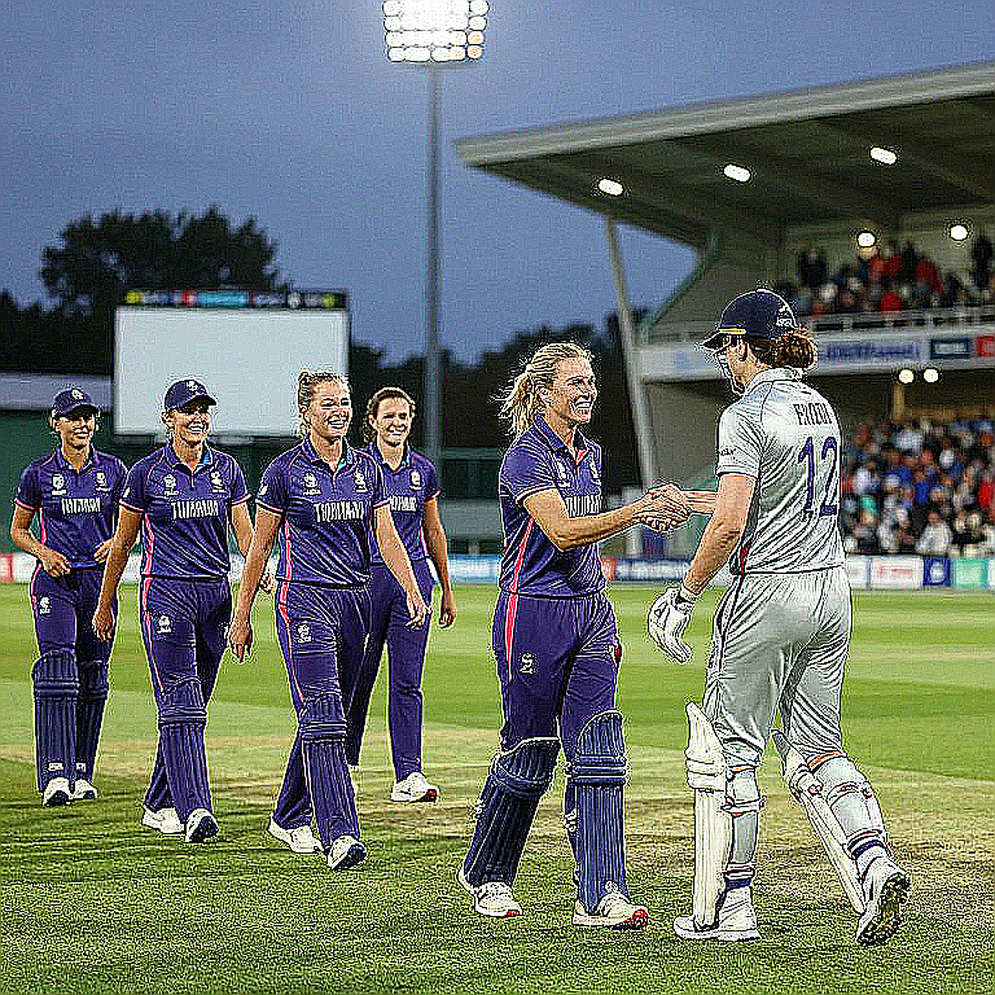
I can see a genuinely positive angle, and I will not pretend otherwise. A pink stadium is not the government of a colour. The light rising off the stumps does not reopen a court case that is already closed. The pink kit does not replace anything, and we end up with something real: an actual care pathway. The named partner is the Pink Ribbon Breast Cancer Trust Hospital in Lahore, described as Pakistan's first dedicated breast cancer trust hospital. This is the one place where the ladder from symbolism to human being has been built. Screening camps are scheduled for 24 and 26 October. That is not paint on paper; that is doctors on the day.
But this is exactly where the arithmetic comes apart.
Second thesis, the most uncomfortable one: the press release contains no figure at all for how much of the pink merchandise revenue goes to the hospital. Follow the trail. Limited-edition pink travel polos and fan shirts will be sold through the official retail store and online platforms — clear. The partnership is with a breast cancer trust hospital — clear. That even one rupee from those shirts will reach the hospital — absent. And the second named voice in the whole release is not the COO. It is the Director of Commercial. When a board's commercial director fronts a health-awareness announcement, the activation belongs to brand equity and revenue, not to welfare. That is not a sin. The sin is that the disclosure statement is not written with the same clarity as the commercial one.
A comparison is needed here, because the board never made it. The benchmark for this model in world cricket is Cricket Australia's Jane McGrath Day — the Pink Test at the Sydney Cricket Ground, running for more than fifteen years, with a published annual fundraising target, audited disbursement, and year-on-year outcome reporting. Pakistan's release has the visual layer: pink kit, pink stumps, pink ribbons, LED boards, merchandise. It does not have the accountability layer. The difference between a one-day gesture and an institution is not measured in rupees. It is measured in publishing habit.
The transparency gap is not confined to merchandise. England's players, match officials and commentary teams have been invited to wear pink ribbons — invited, not instructed. No confirmation of acceptance is given. The visual uniformity the campaign is built around will therefore likely be partial. The Pakistan players' video messages are mentioned, but no player is named. That is the campaign's largest lever left unaccounted for. In Pakistan, a male cricketer reaches people no health department budget can buy. Which face appears on screen decides whether the message lands with women over thirty, or with the husbands and fathers who gate household health decisions. Leaving that undecided is the match's biggest unforced error.
One thing brings me relief. The board did not choose a Test, and it did not choose a T20 league. In an ODI, a single kit change is near-zero interference with the product. In a Test, five days in pink would become an equipment-regulation event; in a franchise league, kit branding is already spoken for. The one-day format is the lowest-friction vehicle — a deliberate choice, not an accident.
So where is the problem? Not in the kit, not in the dew, not in the invitation. In the numbers. At the end of the series the board will issue a statement saying millions were reached. Reached is not a measurement — it is a claim. Without five numbers — how many attended the screening camps, how many were tested, how many tested positive, how many entered treatment, and how much of the shirt revenue reached the hospital — awareness is an estimate. And if reputation is built on an estimate, the same estimate will later tear it down.
A contrary question has to be asked. Is this criticism too harsh? The board is at least doing something, and many boards do nothing. True — but two different things are being blurred: doing the work, and making the work verifiable. In Pakistan's context, public conversation about breast cancer is itself an achievement, because a subject that cannot be named is a subject that does not get screened for. A cricket ground is the cheapest and most powerful tool for breaking that silence. Power and accountability, though, are not the same thing. And if the board later uses that evening as evidence in bids to host ICC events, the question becomes legitimate: evidence by what measure? There is one way to defuse it — publish the numbers the following week, unprompted, before a third party forces the issue.
Another thing surfaces from the tape. Whether this activation reached the host broadcaster — or the broadcaster had already agreed — is left in fog. No sentence describes a formal decision between broadcaster and board. That is an assumption, not an agreement. What is commercially an asset has a second owner, and that hand is invisible here.
One more factor works in Pakistan's favour in this match. Gaddafi's pitch favours batting, the square boundaries are short, scoring rates are high, and dew makes batting second easier. Home advantage in this fixture is structural. So the Pakistan side in the pink kit will most likely bat in the advantageous innings — against the strongest opponent in the tri-series. I will not sell that statistical edge as the virtue of awareness; it is dew's gift, not the colour's. But the reality is simple: win, and the picture is beautiful; lose, and the same pink kit becomes the image of defeat. My second thesis was true after all: the board wrote its own story in a press release, but the result of that story will be manufactured on the field — and the field is not under the board's control.
Late-October Lahore keeps a residual rain risk. A Duckworth-Lewis truncation would make the whole campaign's headline the name of a shortened match. The release acknowledges none of that risk.
So what is the answer? Benchmarked against the international standard, I see two pictures. One holds the visual: pink jersey, pink stumps, pink light. The other holds the ledger: how much money, to whom, in how many lives. The first is built in a day. The second takes five years. Pakistan built the first, and built it well. The second has not been announced. And until it is, this pink kit can never deliver its most valuable answer.
In the next match, watch the numbers, not the kit. If the five figures arrive, the light around the ground was working light. If all we get is millions reached and a historic initiative, then you will know: nothing was bought for the hospital. Only reputation was bought. Or, to put it better — the evening the pink jersey actually saved a life will be written on a shirt receipt, not on the scoreboard.